
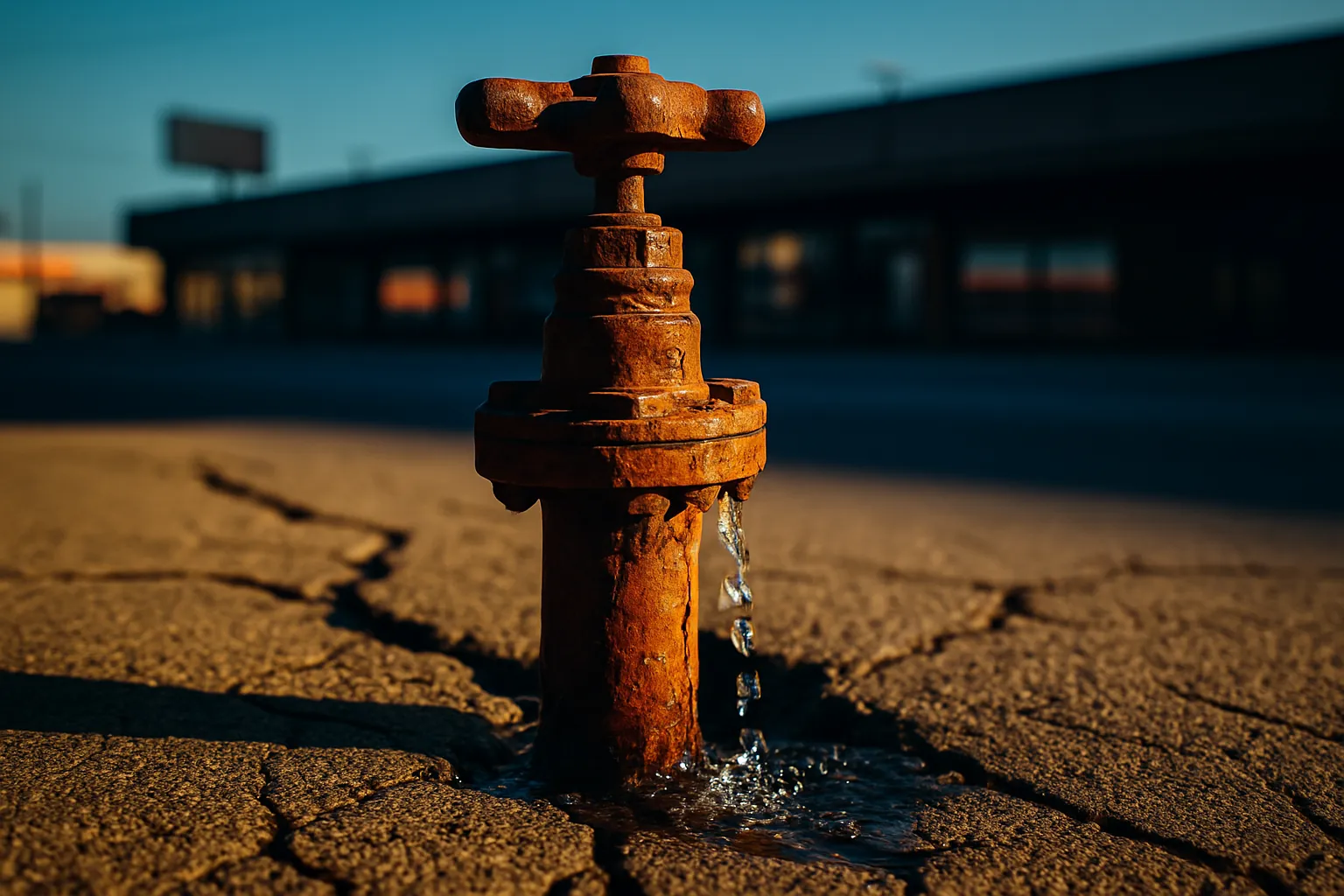
PORT CHESTER, N.Y. — Sirens faded, shop lights blinked out, and for nearly 48 tense hours the beating commercial heart of Boston Post Road fell startlingly quiet. A single rupture beneath the asphalt of Gateway Shopping Center shut down every register, every restroom, and every ounce of daily routine. What began as a Wednesday morning leak ended as a full-scale civic stress test, prompting engineers, merchants, and town leaders to wrestle openly with an unsettling question: Just how close is Port Chester to the next infrastructure shutdown?
The break forced anchors like the local grocery giant, a national pharmacy chain, and four fast-casual eateries to lock their doors. Thousands of workers and customers were suddenly displaced. “We lost water, we lost time, and we nearly lost trust,” said Village Trustee Marisol Vega, her tone matching the gravity of a capital-city briefing. Crews from Veolia Water North America dug through the night while police redirected traffic and health inspectors monitored stagnant pipes for contamination risks. By dawn on Friday, some taps trickled back to life, but the sense of vulnerability only deepened.
Pressure Point: When One Pipe Halts an Entire Economy
On paper, the incident involved a single 12-inch cast-iron main—likely installed before World War II—giving way to age and persistent vibration from nearby truck routes. In practice, that hairline crack severed the daily economic exchange of an entire corridor. Local chamber officials estimate $420,000 in direct sales evaporated during the closure, a figure that ripples outward when suppliers, delivery drivers, and hourly workers are counted. “I missed two full shifts,” said barista Giovanni Ortiz, holding the empty tip jar he usually guards like a vault. “That’s groceries for my kids.”
Experts warn that what happened here is not an anomaly but a flashing indicator. According to the American Society of Civil Engineers, an American water main fails every two minutes. Port Chester has now logged three high-profile breaks in as many years—the December 2022 New Broad Street flood and the January 2023 Irving Avenue rupture among them. Each time, emergency crews respond flawlessly; each time, permanent upgrades stall amid competing budget priorities.
Infrastructure analyst Dr. Selina Moran calls the pattern a ticking clock. “When aging networks reach their stress threshold, minor leaks escalate to system-wide failures,” she told Top Coverage News. “What you saw at Gateway is the visible symptom of an invisible, widening fracture across municipal America.”
From Crisis Response to Long-Term Resilience
The village board convened an emergency session Thursday night, voting 5-0 to commission a 90-day vulnerability audit of all primary lines feeding commercial districts. Mayor Luis Marino framed the measure as non-negotiable. “We cannot afford another domino day,” he declared from the dais. Preliminary figures suggest the study—along with priority pipe replacements—could cost up to $3.8 million, roughly a quarter of the village’s annual capital budget. Officials hint that state resiliency grants may offset portions, but most funding will need to come from local bonds or reallocated road projects.
Small business owners, still calculating losses, appear willing to shoulder part of the bill. “A reliable tap is cheaper than a forced shutdown,” argued bookstore manager Dana Hsu. The Port Chester Retail Alliance, representing 87 storefronts, has signaled support for a special assessment district dedicated to water infrastructure. Their proposal mirrors models in neighboring towns that earmark cents-on-the-dollar surcharges to finance underground upgrades.
Practical tip: Residents concerned about pipe integrity in older homes should schedule a simple pressure test. Local plumbers say the check costs under $100 and can forewarn of weak joints before they burst.
Outside voices amplify the urgency. In a similar 2023 episode, Yonkers endured a five-day boil advisory after a 24-inch main collapsed, costing the city nearly $1 million in overtime and bottled-water deliveries (News12 Hudson Valley). “Port Chester is at a fork in the road,” said Dr. Moran. “Invest now or pay later—with interest.”

Hidden Costs and the Human Toll
Behind the talking points lie quieter hardships. School buses had to reroute because temporary road plates narrowed lanes; wheelchair users reported difficulty navigating hastily erected pedestrian detours; parents scrambled to find restrooms for children during midday errands. “Water main break emergency response drills never cover my six-year-old needing a restroom now,” said local mother Aisha Grant.
Public health officials also note the increased risk of bacterial infiltration during pressure drops. While no contamination was detected this time, the CDC links sudden depressurization to spikes in E. coli presence. “Every break is a potential health crisis until proven otherwise,” cautioned county epidemiologist Dr. Nate Collins. He urged anyone who observed discoloration or odd tastes after service resumed to flush household lines for at least 15 minutes.
Meanwhile, firefighters temporarily trucked in water to maintain hydrant readiness. “A dry hydrant during a house call is my worst nightmare,” said Chief Elena Ramos, standing beside a temporary tanker. Her crew’s contingency measures added overtime costs now under review by the village finance committee.
For many residents the outage resurfaced older anxieties. “We keep talking about 100-year-old pipes like they’re heirlooms,” said retiree Carlos Menendez, echoing sentiments captured after the 2022 downtown flood (News12 Westchester). “But heirlooms belong in museums, not under roads.”
Quick safety reminder: If you experience a sudden loss of water pressure, immediately shut off your main valve and call the village hotline at 914-939-5200. Early reporting can limit road damage and reduce repair times.
Where We Go From Here
As Gateway Shopping Center flickered back to life Friday evening, a cautious optimism settled in. Yet each reopened storefront carried fresh signage advising customers that restrooms might remain closed during off-peak hours while pipes stabilize. The small red notices served as daily footnotes to a broader narrative: Port Chester’s infrastructure story is still being written.
Engineers will spend the next two weeks pressure-testing adjacent mains, mapping corrosion, and installing acoustic sensors that listen for leaks before pavement buckles. The Department of Public Works also plans a public dashboard showing real-time pipe age, break history, and replacement schedules—an unprecedented transparency measure for a village of 30,000. “Data builds trust,” said DPW Director Thomas Wilkerson.
On the legislative side, trustees hinted at enacting a 30-year capital plan, ensuring that pipe replacement cycles keep pace with material lifespans. If adopted, the framework would insulate critical projects from annual budget battles, making water reliability a standing priority rather than an emergency line item.
The local school district, whose cafeterias briefly turned to bottled supplies, is already drafting a resilience curriculum for fourth graders. The lesson? Infrastructure is invisible—until it fails. Superintendent Dr. Leigh Jordan believes early awareness fosters stewardship. “When kids grasp why a pipe matters, they grow into voters who fund maintenance,” she said.
Even ordinary shoppers appear changed. Call it quiet vigilance: glances toward ceiling sprinklers, questions about backup generators, a newfound respect for the gray valve in the janitor’s closet. The next time a faucet runs clear, residents will remember the day it didn’t—and the rapid mobilization that turned a break into a wake-up call instead of a catastrophe.
For now, Port Chester exhales but does not relax. Beneath freshly patched asphalt, water rushes through aging cast iron, carrying with it both the lifeblood of local commerce and the weight of unavoidable decisions ahead. If the village seizes this moment, last Wednesday’s rupture may be remembered less as a disaster than as the turning point when a community chose resilience over routine.