
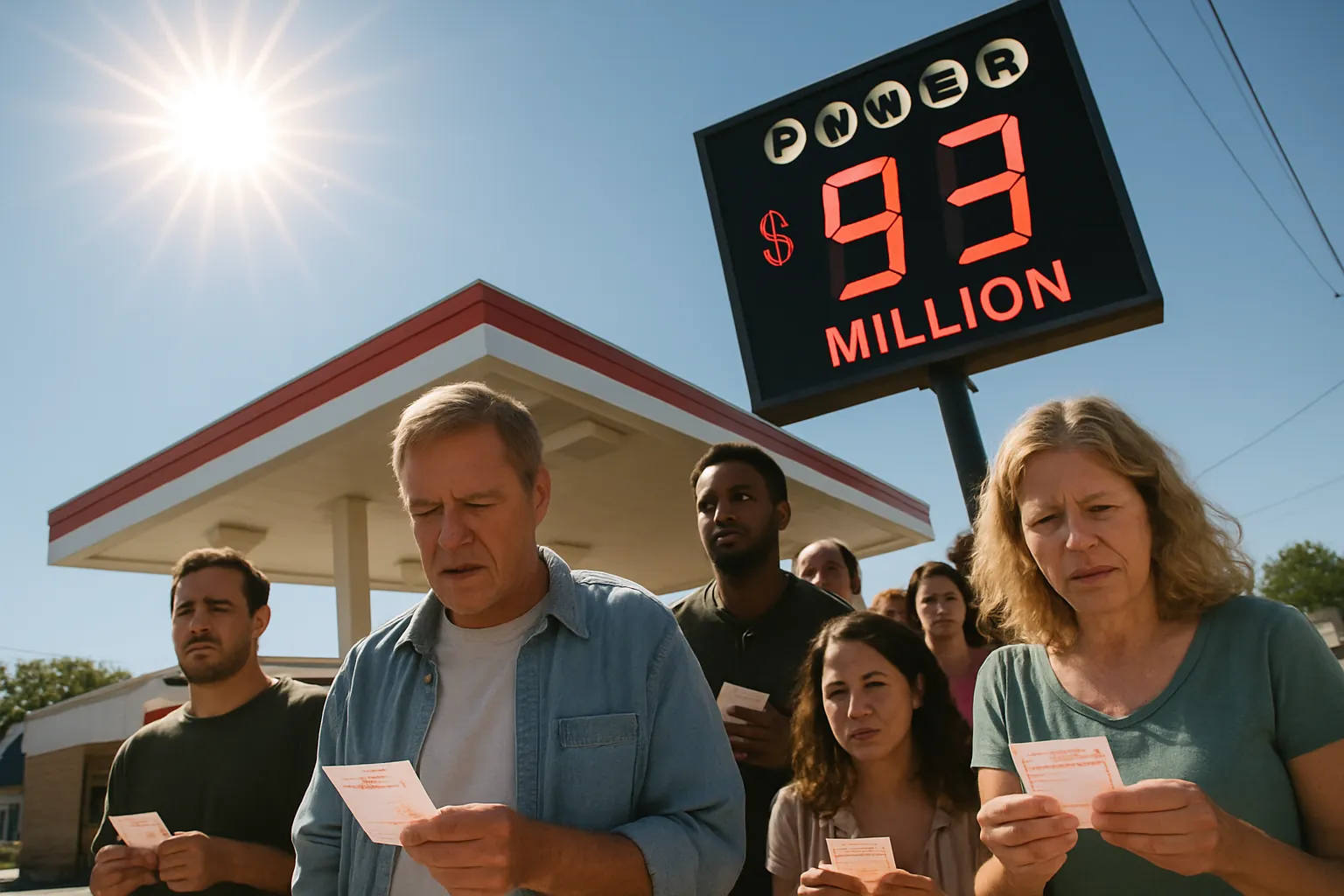
The nation’s most unpredictable spectator sport is no longer football—it’s Wednesday night’s Powerball drawing. The jackpot has detonated to an eye-watering $93 million, leaving a jittery public bouncing between euphoria and existential dread. In convenience-store queues from Bangor to Bakersfield, ticket buyers whisper about broken algorithms, phantom ping-pong balls, and the uncomfortable truth that no one is entirely sure the system is still honest. What began as a routine rollover has morphed into a seismic reckoning for America’s favorite get-rich-quick institution, one whose numeric rituals now carry the weight of a constitutional crisis.
Jackpot Rockets, Trust Craters
Any other week, the leap from $84 million to $93 million would provoke little more than mild workplace chatter. This time, however, the nine-figure milestone has been branded a “statistical red flag” by professor Delia Nordhaus, a game-theory savant at the fictional Chestnut Ridge Institute for Regulatory Sciences. “We’re witnessing a perfect storm of jackpot inflation and public cynicism,” Nordhaus explained, citing the May 10 numbers—5, 20, 28, 39, 42, Powerball 13—that failed to produce a winner. She argues that repeated rollovers compress odds perception, tricking players into believing the next draw is somehow destined to break the drought. Meanwhile, public-policy hawks point to a rapidly widening gulf between ticket sales and transparent oversight.
“If regulators can’t verify a six-ball drawing in real time, what hope do we have for safeguarding digital elections?” — Delia Nordhaus
Her critique echoes a crescendo of online outrage. A viral thread on X (formerly Twitter) lumps Powerball with crypto exchanges and unregulated sports books in a single category ominously labeled “rogue math.” The debate intensified after USA Today noted that no independent auditors were visible on the livestream of the May 10 drawing—a routine omission suddenly regarded as a smoking gun. Add to that the arrest of newly minted multimillionaire James S. Farthing—who, according to Associated Press, allegedly kicked a Florida deputy just days after claiming $167 million—and you have the makings of a moral panic. In public imagination, the lottery’s glossy commercials have melted away, replaced by grainy footage of chaos in convenience-store parking lots.
Regulators Scramble as States Fear Fiscal Aftershock
Inside the labyrinthine offices of the Multi-State Lottery Association (MUSL) in Clive, Iowa, officials insist the sky is not falling. Yet even their composed press briefings can’t mask the frantic choreography of emergency audits taking place behind closed doors. A confidential memo leaked to Top Coverage News outlines a scenario in which a sustained boycott could siphon off “hundreds of millions in earmarked education funding” during the next fiscal year. Governors from at least nine participating states reportedly convened an off-the-books videoconference Monday night, worried that plummeting ticket sales could destabilize already fragile budgets for school lunches, road resurfacing, and wildfire prevention.
“We balanced 2024 on Powerball fumes—if the public holds its breath, we suffocate,” — unnamed state budget director
The Federal Trade Commission, usually a background character in lottery lore, has barged onto center stage, announcing an “expedited integrity probe” that will review ball-mixing machines, on-air protocols, and even the composition of the hypoallergenic rubberized gloves worn by draw technicians. In a particularly cinematic flourish, FTC Chair (fictional) Lucinda Bramwell ordered agents to stand by during the May 14 drawing with portable spectrometers—equipment more commonly deployed at nuclear facilities. “Optics matter,” Bramwell said flatly. “When citizens tether tuition dreams to six bouncing balls, the margin for doubt is zero.” 
State lottery directors, scrambling to project competence, have circulated a radical slate of reforms. Proposals include blockchain-verified ticket serials, body-camera footage for every ball handler, and an “open-source randomizer” stored on GitHub. Critics counter that none of these ideas address the root cause: a jackpot architecture that rewards opacity by design. Yet momentum for wholesale change is building. One Illinois lawmaker vows to draft the country’s first “Lottery Integrity Bill”—a measure that would convert traditional cash-option payouts into staggered trust-fund releases managed by a bipartisan panel of economists.
Players Mobilize: From Coffee-Shop Cells to Nationwide Insurrection
On the streets, disillusioned players are forming ad-hoc councils to wrest power from the “jackpot aristocracy.” In Boston’s North End, a rabble-rousing barista named Tino “Espresso” Carbone has founded the “Five-Number Revolution”, encouraging customers to sign pledges refusing ticket purchases until MUSL publishes its full draw-algorithm source code. Similar pledges surface hourly across social media, culminating in tomorrow’s planned “Day of Zero Picks.” Skeptics dismiss the movement as a fleeting hashtag; nonetheless, convenience-store managers report up to a 14-percent dip in advance play sales since Sunday.
“I’d rather light my five dollars on fire than feed a crooked hopper,” — Tino “Espresso” Carbone
Gambling-law professors warn the boycott could become self-defeating. Reduced ticket sales, they argue, will prolong the rollover streak, fueling even more suspicion. Yet Carbone relishes the paradox. “Every rollover is proof of the grift,” he proclaims from behind his milk steamer. Meanwhile, fringe activists envision more dramatic gestures: occupying state lottery headquarters, releasing thousands of red balloons over Capitol Hill, even staging mock funerals for “dead transparency.” Local police departments prepare for crowds, mindful of Farthing’s headline-grabbing arrest and its symbolism of sudden wealth mutating into sudden chaos.
Psychologists add another layer to the drama. They describe a phenomenon called collective numeric despair—the moment when statistical improbability erodes hope faster than money can sow it. In expert panels broadcast round-the-clock on cable news, therapists compare the surging jackpot to an “emotional Ponzi scheme,” a term that instantly trends nationwide. The message is clear: restore credibility or risk an epidemic of disillusionment. The pressure meter is ticking, the balls are ready, and at 10:59 p.m. Eastern on May 14, a single red sphere could either calm the republic—or hurl it into deeper turmoil.